

Regenerative Agriculture: Agroforestry Opportunities Using Technology
- Freddie Ryan
Agroforestry in Scotland
Agroforestry, the integration of trees with agricultural landscapes, is experiencing continued uptake in Scotland, boosted by a 50% increase in grant funding. This regenerative agriculture practice offers a multitude of benefits, both tangible and ecological, making it an attractive option for forward-thinking land managers, agents, consultants, and developers. At Rethink Carbon, we’re enabling this movement with technology, armed with the Rethink Platform — a user-friendly tool designed to empower land managers with data-driven insights.
The Forestry Grant Scheme
From orderly rows to more organic groupings, agroforestry offers farmers the flexibility to tailor their farming approach to suit the unique terrain of their land. The Forestry Grant Scheme (FGS) further supports this flexibility, with planting thresholds ranging from 150 to 400 trees per hectare, accommodating a mix of needs and preferences.
The FGS includes eligible land for planting as permanent grassland pasture, temporary grassland, or arable land (often found within Land Capability for Agriculture Classes 1.1 to 4.2). Our analysis shows there are 2.16 million hectares of soils within this range in Scotland, highlighting the scale of opportunity. Our interactive 3D map demonstrates these LCA classes in yellow.
James Hutton Institute – Land Capability for Agriculture (250k): Soil Survey of Scotland Staff (1981). Land Capability for Agriculture maps of Scotland at a scale of 1:250 000. Macaulay Institute for Soil Research, Aberdeen. 10.5281/zenodo.6322683
Benefits of agroforestry
Beyond the financial advantages of agroforestry, such as timber yield and increased productivity, agroforestry offers a host of ecological perks.
- Trees enhance soil structure, mitigating flood risks by absorbing water
- Agroforestry can provide vital habitats for biodiversity year round
- Trees, other plants and stable soils serve as a natural carbon sink, with research by the Woodland Trust showing potential carbon sequestration rates of up to 16 tonnes of CO2e per hectare per year
Funding opportunities
Under the Forestry Grant Scheme, support of up to £5,400/ha is available for qualifying agroforestry projects, including both initial planting and ongoing annual maintenance — a significant incentive for land managers seeking to implement sustainable land management practices.
Agroforestry represents just one piece of the puzzle in Scotland’s journey towards a more diversified and integrated landscape. Complemented by initiatives like the Agri-Environment Climate Scheme (AECS), woodland planting, hedgerow planting and wetland creation, agroforestry forms part of a holistic approach to achieving Scotland’s climate and biodiversity targets while unlocking new revenue streams for landowners.
Navigating agroforestry
Inside the Rethink Platform
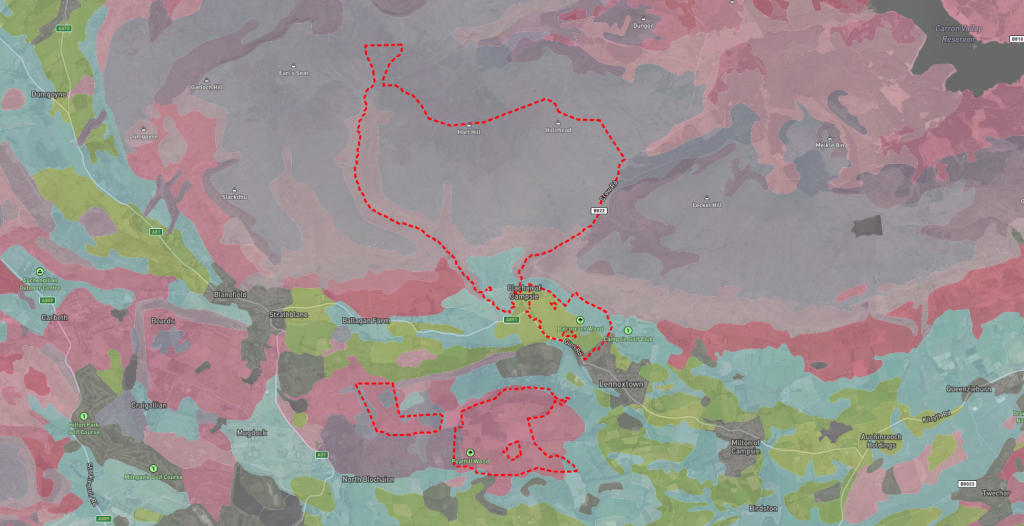
James Hutton Land Capability for Agriculture (50k)
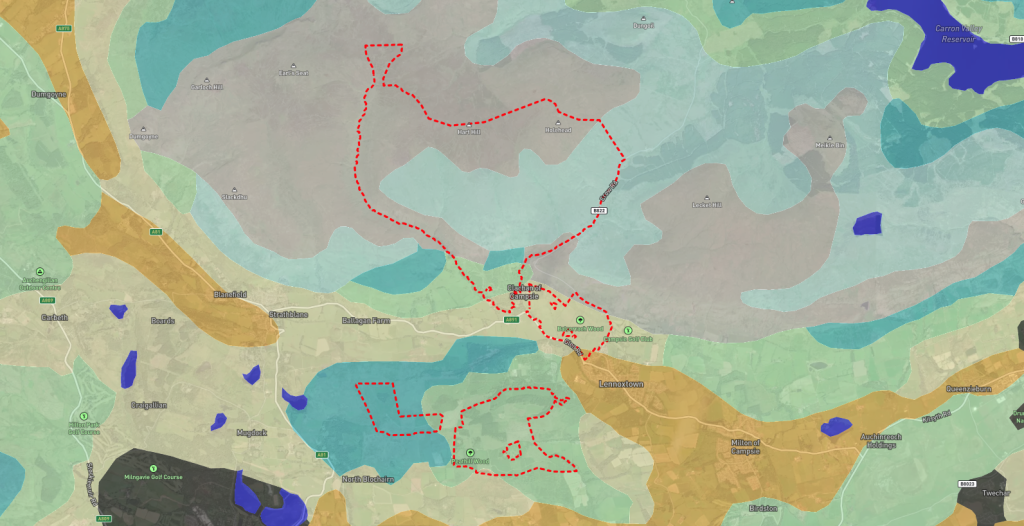
James Hutton Land Capability for Forestry (50k)

SEPA River Depth Flood Risk
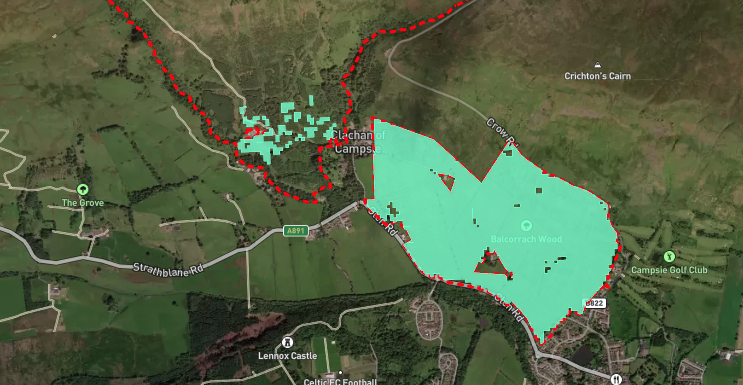
Scottish Forestry AECS opportunities for agroforestry
Navigating the complexities of regenerative practices and assessing its potential impact can feel like a big step. The Rethink Platform simplifies this process by identifying opportunities, providing tailored guidance on suitable tree species, grant funding opportunities, and carbon sequestration potential.
With a few clicks, users can input their land boundaries and unlock a wealth of information. Our mapping tools identify prime agroforestry zones, considering soil quality, microclimates, and ecological factors. Income calculators project financial returns, ensuring decisions align with both profit and planet.
By embracing agroforestry, land managers can not only future-proof their operations but also contribute to Scotland’s climate and biodiversity targets. With the Rethink Platform as your guide, why not reimagine Scotland’s agricultural landscape, cultivating a future where productivity and environmental stewardship go hand in hand.